
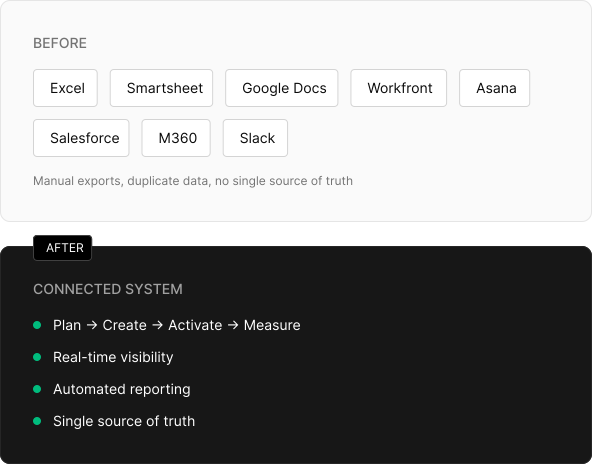
Campaigns, creative, approvals, and reporting are running across too many disconnected tools. That's why everything feels slow, reactive, and impossible to scale even when your team is working hard.
We help enterprise marketing teams build the connected operating system behind their work, from campaign planning to creative production to real-time reporting.
.svg)
Two launches. Same audience. Same week. No one knew until it was too late. Your calendar exists it just doesn't actually prevent conflicts.
.svg)
Creative sits in inboxes waiting for sign-off. By the time it's approved, the window has shifted. The team scrambles. Again.
.svg)
Your analytics team spends more time pulling data than analyzing it. By the time the numbers arrive, the campaign is already over.
.svg)
Brand doesn't know what demand gen is running. Regional doesn't know what global has approved. Everyone's working hard, but nobody's working connected.
1.svg)
Sheets. Asana. Slack. Dropbox. Drive. Every tool holds a piece of the story. None of them tell the whole one.
.svg)
Your team buys the software. Builds a few things. Then quietly goes back to spreadsheets. The system never sticks because it was never designed around how marketing actually works.
From our calls with marketing teams: "The goal is to extract this from that absolute beast of a Google Sheet and put it somewhere digestible." That\'s not a data problem. That\'s a systems problem.
Most enterprise marketing operations aren't running as a system. They're running as a collection of point solutions stitched together with manual work, workarounds, and institutional memory that walks out the door when someone leaves.
When a campaign slows down, the real question isn't "who dropped the ball?" It's "where in the system did it break?" Most teams can't answer that because they've never built the system.
The marketing operations that scale aren't doing more. They're operating differently. Every phase of their work is connected.
THE MARKETING LIFECYCLE
A high-performing marketing operation runs as one connected loop

Campaign calendaring, conflict detection, brief development, stakeholder alignment
.svg)
Go-live coordination, asset distribution, channel readiness, real-time response
.svg)
Creative production, resource management, approvals, asset tracking
Performance aggregation, operational insights, multi-level reporting, feedback into planning
When one phase breaks, every phase downstream suffers. Most teams have parts of this working. Almost none have it working as a connected whole.

One place where every campaign lives from brief intake to launch to post-campaign reporting. No more hunting across tools.
.svg)
Real-time visibility into what's in flight, what's at risk, and what's shipping next. Leadership stops asking for status updates because the system answers before they ask.
Clear ownership at every stage. Approvals route automatically. Handoffs happen without emails. Nothing falls through because the system doesn't allow it.
Faster launches with fewer heroic efforts. Your team stops firefighting because conflicts are caught before campaigns are approved, not after they've launched.
Reporting that's always ready. Your analytics team stops spending 80% of their time gathering data and starts spending it on insights that actually influence next quarter's decisions.
A system your team actually uses. Because it was built around how they work not around what looked good in a demo.
This isn't a future state you stumble into. It's one you design. That's exactly what we do.
Most marketing teams don't have a tool problem. They have an architecture problem. The issue isn't the number of platforms it's that none of them are connected to each other in a way that creates a single source of truth.
Airtable provides the infrastructure that makes a connected marketing operating system possible:
.svg)
Campaigns, briefs, assets, and performance all live in one place and update in real time
.svg)
Map to how your team actually operates not a rigid methodology someone else designed
.svg)
Surface conflicts, detect bottlenecks, and generate insights before problems become crises
From individual campaign status to executive portfolio views without manually building reports
But infrastructure alone doesn't fix the system. That's where implementation makes or breaks everything.
Here's the pattern we see constantly. A marketing team recognizes the problem. They buy Airtable. Someone builds a few bases. Adoption is mixed. Six months later, half the team is still in spreadsheets and the other half is using the system in ways it was never designed for.
The platform didn't fail. The implementation did.
.svg)
.svg)
A connected marketing system has to be designed around your specific workflows your campaign types, your approval chains, your team structure, your reporting requirements.
It has to be built for the people who will use it daily, not just the stakeholders who approved the budget.
And critically: adoption has to be part of the design. Not a training session at the end.
Optimize IS has delivered connected marketing systems for enterprise teams at Autodesk, Cisco, Walmart, Levi's, Mattel, Fanatics, and more. We are Airtable's 2024 Services Partner of the Year, with over 1,000 implementations completed across global organizations.
We don't start with software. We start with how your team works, where the system breaks, and what a connected marketing operation needs to look like for your specific organization.
01
We design how your entire marketing operation connects campaign calendars, brief workflows, creative production, asset management, and reporting as one integrated system. No guesswork. No duct tape.
What you get:
.svg)
02
We build the actual workflows your team will use every day. Campaign intake, brief approvals, creative handoffs, go-live coordination. Everything mapped to how marketing actually runs, not how a vendor's template assumes it does.
What you get:
.svg)
03
We connect performance data so it flows automatically from activation through to leadership reporting. Your ops team stops pulling numbers. Your CMO stops waiting for slides. Everyone sees the same information at the right level of detail.
What you get:
04
We build for the person who has to use the system at 4pm on a deadline, not just the executive who approved it. Adoption is designed in from day one. We also provide dedicated training and long-term support to ensure the system keeps delivering value as your team and priorities evolve.
What you get:


.svg)
.svg)
.avif)
We are grateful for the success we’ve brought to our clients. They’ve been kind enough to share their experiences with you. Here is a small sample of the hundreds of testimonials and 5-star ratings we’ve received.
Reduction in reporting time time marketing ops gets back from manual data consolidation
Campaigns that launch faster, with fewer collisions and less emergency pivoting
Creative production cycles that shorten because approvals, handoffs, and feedback are built into the system
Airtable systems that survive platform consolidation reviews because they were designed well enough that leadership chooses to keep them
In a single working session, we'll map your current marketing operation, identify exactly where the system is breaking down, and show you what a connected system would look like for your team and your workflows.
This is not a sales pitch. It's a working session with people who have built marketing systems for some of the largest teams in the world.
What You Walk Away With:
.svg)
Where it's failing across Plan, Create, Activate, and Measure
Against how a high-performing marketing operation should run
Built for your specific team structure, campaign types, and reporting requirements
You can act on whether you move forward with us or on your own
30-minute session. No commitment required. We work with enterprise marketing teams at Fortune 500 companies if that's you, let's talk.
The campaigns, creative work, and reporting your team is capable of none of it can scale on a foundation of disconnected tools and manual workarounds.The marketing teams winning right now aren't necessarily bigger or better resourced. They've built the operating system behind their work. That's the difference.


