.svg)
.svg)
.svg)
.svg)
.svg)

.png)
.svg)

Roadmaps, delivery, dependencies, customer feedback, and analytics should live in one connected system, not a relay of tools that never agree. We build the operating system that connects strategy to execution, so product organizations move faster as priorities shift. Built for Chief Product Officers and product operations leaders.

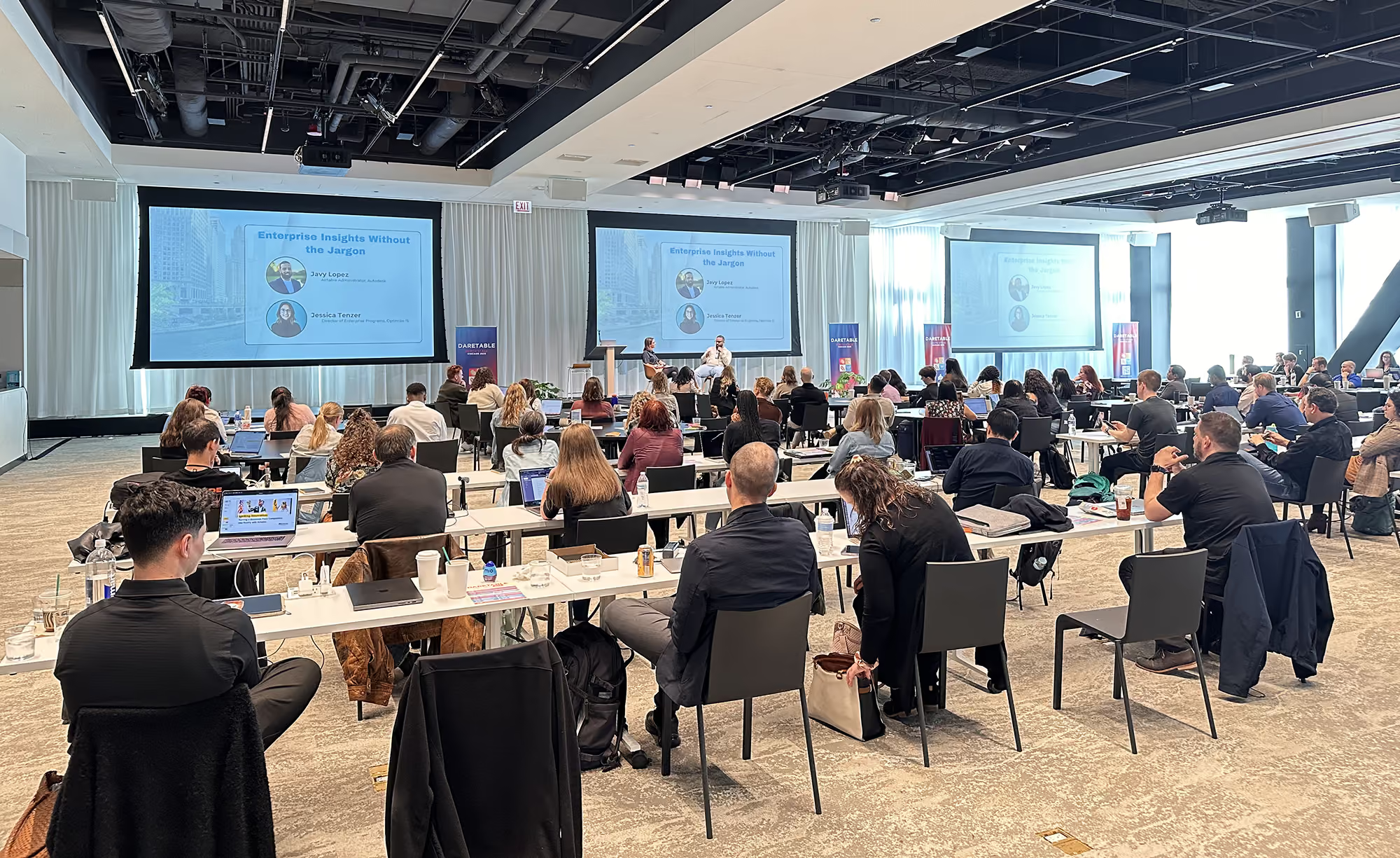
Product organizations do not lack talent or ambition. They lack a connected system, so the work of coordinating the work eats the time meant for building it.
The roadmap lives in one tool, delivery in another, customer feedback in a dozen inboxes and tickets, and the status leadership reads lives in a deck a PM rebuilds every week. Cross-team dependencies are tracked in nobody's tool. Release readiness is assembled by hand each sprint. Product, design, and engineering data never quite line up, and feedback that should shape the roadmap gets lost.
Meanwhile planning cycles keep shrinking. Teams are expected to be more agile and iterative, adjusting features as fast as expectations change. When product planning, delivery, and feedback live in one connected system, the CPO can move faster and re-resource the team to fast-changing priorities, because the work, the people, and the priorities are finally connected in one place. That is also what makes a product organization AI-native: AI can synthesize feedback and inform roadmaps only when the underlying data is connected and trustworthy.
Roadmap in one tool, delivery in another, status in a deck
Customer feedback scattered across inboxes and tickets
Cross-team dependencies tracked in nobody's tool
Resourcing decisions that lag fast-changing priorities
Release readiness assembled by hand each sprint
PMs spending more time reporting than deciding
%201.avif)
What recent research says about where product and engineering time actually goes.
of product teams lack time for strategic planning, roadmaps, or analysis
Atlassian State of Product, 2026 · source
strategic-empowerment advantage for teams with a product ops function
Atlassian State of Product, 2026 · source
of developers face constant context switching; the average dev juggles 14 tools
Harness, 2024 · source
of software features are rarely or never used, much of it from weak feedback loops
Pendo, 2024 · source
Every enterprise operates somewhere on this spectrum. We help you move to the next state, with the foundation to keep moving.
Most teams start here
Disconnected tools. Manual reconciliation. Spreadsheet sprawl. Data lives in a dozen places and teams work around the system instead of with it. Every quarter feels harder than the last.
Where our clients live
One operating system across teams. Clean data architecture. Workflows that match how the team actually works. Automation where it adds value. Reporting that reflects reality.
The AI decade
Connected systems plus the AI layer that compounds them. Predictive signal that works because the data foundation is clean. It only works on top of Connected Systems. There is no shortcut.
AI transformation firms will sell you Intelligent Operations on top of Fragmented Operations. The result is faster chaos. We build the connected foundation that makes the next state possible.
One system of record from strategy to execution, mapped to how product, design, and engineering actually work together.

Strategy to execution in one connected system, so the plan, the work, and the outcomes stop living in separate tools that never agree.

Roadmap-to-delivery workflows with cross-team dependencies made visible, so nothing stalls in the gap between two teams.

Aggregate feedback and market signal from every source, then use AI to synthesize it into insight that actually shapes the roadmap.

A real-time roll-up of every team-level roadmap into one executive view, so leaders see status without a PM rebuilding a deck.

Connect work to people to priorities, so when the company pivots, you can re-resource the team in one place instead of weeks of spreadsheets.
.svg)
AI in the context of your workflow, with control over where and how it works, down to the prompt. Model-agnostic, never locked to one provider.
Enterprises that unified strategy, delivery, and feedback on a connected Airtable system have seen outcomes like these.
A global financial enterprise moved roadmap and progress data out of wikis, email, chat, and spreadsheets into one system with tailored leadership views, doubling product velocity and saving 580 hours per month.
A leading software company built one centralized hub mapping customer research to business priorities across global teams, collapsing research lead times and proving customer obsession with hard metrics.
A dam looks simple from the outside. Inside, it converts turbulent force into something controlled and dependable. The complexity lives inside the system. What your team experiences is clarity.
We map the friction. Where workflows break, where data lives, where the team is working around the system instead of with it.
We architect the connected system. The right tools, data structure, and ownership, mapped to how your team actually works.
We build, integrate, and migrate. Airtable, AI, custom code, and your existing stack. Your team is involved at every step.
We embed for ongoing operations. We document everything. You own the system. We are there when it needs to evolve.
manual workflows we have automated
given back per week, per team
enterprise systems shipped
five-star client reviews






.svg)
.svg)
.avif)
We are grateful for the success we’ve brought to our clients. They’ve been kind enough to share their experiences with you. Here is a small sample of the hundreds of testimonials and 5-star ratings we’ve received.
Focused scale, not freelancers
135 certified implementers, more than five times the next largest competitor. Depth across every workflow your business runs.
The re-sourcing guarantee
If a resource is not the right match, we get ahead of it and fix it. You never have to fight for a resolution. Finding the right person is on us.
Embedded, not parachuted in
We embed on your team and hold the institutional knowledge of your systems long after launch, through turnover and new complexity.
Forward-deployed AI engineering
We embed senior AI engineers to build the operational foundation that makes AI investments actually deliver, instead of layering intelligence on broken operations. We stay model-agnostic, so your strategy is never tied to one provider.
Yes. AI for prioritization, feedback synthesis, and drafting needs trustworthy product data. We build that connected foundation first, then layer AI in the context of your workflow, with control down to the prompt. We are forward-deployed AI engineers and stay model-agnostic, with no lock-in to a single provider.
Yes. We connect to the delivery and analytics tools your engineers already use through supported integrations, pulling their data into one holistic view of the product organization rather than replacing what works.
Because work, people, and priorities live in one system, you can re-resource against a shifting roadmap in one place, and leadership sees the impact in real time instead of waiting for the next planning cycle.
By removing process. When status is live and dependencies are visible, PMs stop building weekly decks and chasing updates. The system does the reporting so people can do the deciding.
You do. We document the architecture, train your team, and hand over a system you control. The Embedded Partnership evolves it as your product org grows, sized to what you need, with the re-sourcing guarantee behind every placement.
A hire brings one person's bandwidth and knowledge. We bring 135 certified implementers, document everything so the system outlasts any individual, and back it with the re-sourcing guarantee. Many teams use us to build, then run lean internally.
Change management is built into every engagement, not bolted on at the end. Our four-phase approach, Align, Design for Behavior, Enable, and Reinforce, defines the executive why, designs governance and role-based access in from the start, trains each team on its real workflows, and reinforces with adoption dashboards and 30, 60, and 90 day reviews. That is how engagements reach the outcomes leaders care about: around 90% active adoption, a roughly 75% drop in manual reporting, and the full retirement of shadow spreadsheets.

